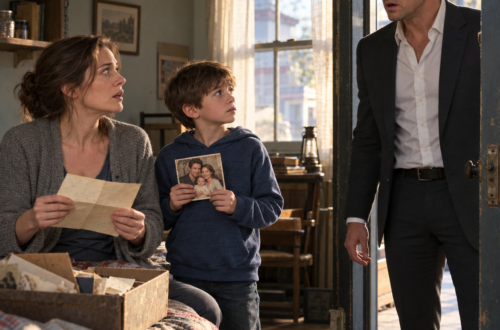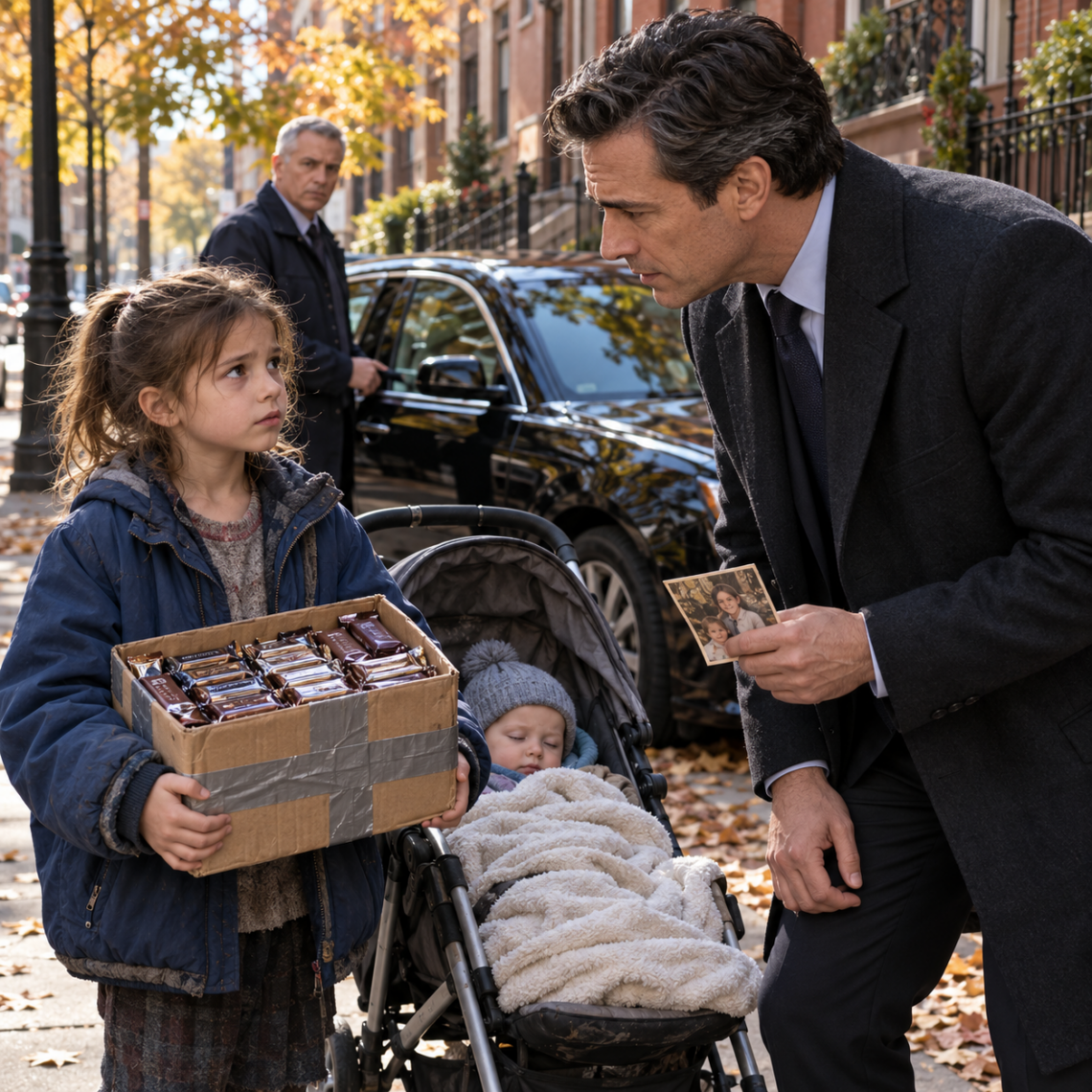
“Frank… who are these children?”
Before my driver could answer, the little girl spoke.
“He told us you’d stop here.”
I looked at Frank.
For seventeen years, he had driven me to meetings, waited outside hospitals, and taken calls I couldn’t bring myself to answer. I knew how he looked when traffic made us late.
I had never seen him look afraid of me.
“Answer me.”
“They’re my grandchildren.”
The girl tightened her grip on the stroller.
“You promised you wouldn’t be mad at him,” she said.
That stopped me.
I lowered my voice.
“What’s your name?”
“Lucy.”
“And your brother?”
“Ben.”
Ben coughed again. Lucy immediately turned toward him, forgetting the adults.
I took out my phone.
Whatever Frank had arranged, it could wait long enough for us to get those children somewhere warm.
We went to the pediatric clinic two blocks away.
Frank carried the cardboard box while Lucy pushed the stroller. I walked beside them.
In the waiting room, she began counting the candy.
“You don’t have to sell those now,” I said.
“There are forty-three.”
“I’ll buy all forty-three.”
She studied me before allowing Frank to take the box.
It wasn’t gratitude I saw.
She was deciding whether I could be trusted.
While the children were with the clinician, Frank sat beside me.
“Why didn’t you tell me you had grandchildren?”
“I did. When Lucy was born.”
I searched my memory.
A photograph on his phone. A little pink hat. Me telling him congratulations while reading something my brother had sent.
I remembered now.
“How is your daughter?”
“Anna’s in the hospital.”
He clasped his hands.
“She collapsed at work yesterday. Her neighbor stayed with the children overnight.”
“And this morning?”
“Lucy found the candy Anna sells at the laundromat. She wanted to help.”
“Where were you?”
“Driving you.”
I looked at him.
“You could have asked for the day off.”
“I needed more than a day.”
Frank handed me a folded notice.
At the top was the name of one of my property companies.
Below it was Anna’s address.
She had lived in a building we bought the previous winter. I remembered approving renovations. Every displaced tenant was supposed to receive money for moving expenses and temporary accommodation.
Anna’s notice said her assistance had already been paid.
Attached was a receipt bearing her signature.
“She never received it,” Frank said.
I read the amount.
Twelve thousand dollars.
“Did she contact the office?”
“Six times.”
He showed me the emails.
Each reply came from the same person.
My brother, Vincent.
Vincent managed the properties because I trusted him.
At board meetings, he called the relocation program one of our proudest achievements.
I had repeated that phrase at a charity dinner.
Now Frank showed me a photograph of Anna’s belongings stacked beside a dumpster.
“She lost the apartment. Then she lost the cleaning work in that building. She’s been staying wherever someone has room.”
“What about your place?”
“They’ve been with me some nights. I rent one room. The owner threatened to put all of us out.”
Frank looked down.
“I asked Vincent to help.”
“What did he say?”
“That if I brought family problems into your business, you’d find another driver.”
“Why did Lucy recognize me?”
“Your picture was on the letter the company sent. Anna pointed it out.”
“What did she tell her?”
“That you owned the building.”
I remembered the fear on Lucy’s face when I stepped out of the car.
To her, I wasn’t a stranger offering help.
I was the man whose name appeared on the papers that had emptied her home.
“You arranged this,” I said.
Frank nodded.
“I knew where you’d be at that hour. I asked Anna’s neighbor to bring them to the clinic. Lucy was already carrying the candy.”
He swallowed.
“I told her to wait near the entrance. I stayed where I could see her.”
“Why not just give me the papers?”
“I tried.”
“When?”
“Last Thursday. You told me to take it to Vincent.”
I remembered that, too.
Frank had stood beside my office door holding an envelope.
I had never looked up.
The clinician called us back.
Ben needed treatment and a return visit. Lucy sat beside the examination table, still wearing her oversized jacket.
When she saw Frank, she asked, “Did he believe you?”
“Yes,” he said.
Then she looked at me.
“Mom said you gave us money. But we couldn’t find it.”
I knelt so she didn’t have to look up.
“I’m going to find out where it went.”
“Does that mean we can go home?”
I couldn’t promise her the old apartment.
So I didn’t.
“It means you’ll have somewhere safe to stay tonight.”
Outside the clinic, I called Vincent.
“Did Anna Bell receive her relocation payment?”
A pause.
“Who?”
“Frank’s daughter.”
His voice changed.
“Nicholas, Frank’s been emotional lately. You shouldn’t—”
“I have the receipt.”
“Then you have proof she was paid.”
I looked at the signature.
Anna’s emails had all been signed with a distinctive loop beneath her name.
The receipt had none.
“Send me the transfer record.”
“I’m away from my desk.”
“Send it.”
By evening, our accountant had found the payment.
It had gone to an account used by an outside relocation service.
Then she found eleven more.
The service belonged to a company Vincent had never disclosed to us.
We preserved the records and brought in independent help to investigate.
I didn’t call him again that night.
There were twelve families to locate first.
Frank stayed with the children while I visited Anna.
She listened without interrupting.
When I finished, she asked one question.
“Would you have come if they hadn’t been standing there?”
I wanted to say yes.
But her emails had reached my company. Her father had reached my office.
And neither had reached me.
“I should have come sooner,” I said.
A week later, Lucy handed me an empty chocolate wrapper.
“For your wallet.”
“Why?”
“So you remember.”
I put it behind my business cards.
Forty-three bars had cost me forty-three dollars.
Finding out why a little girl was frightened of me cost considerably more.
This is fictional.