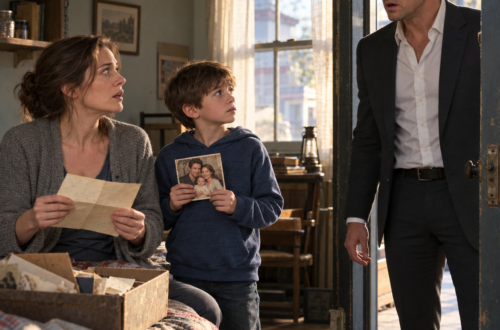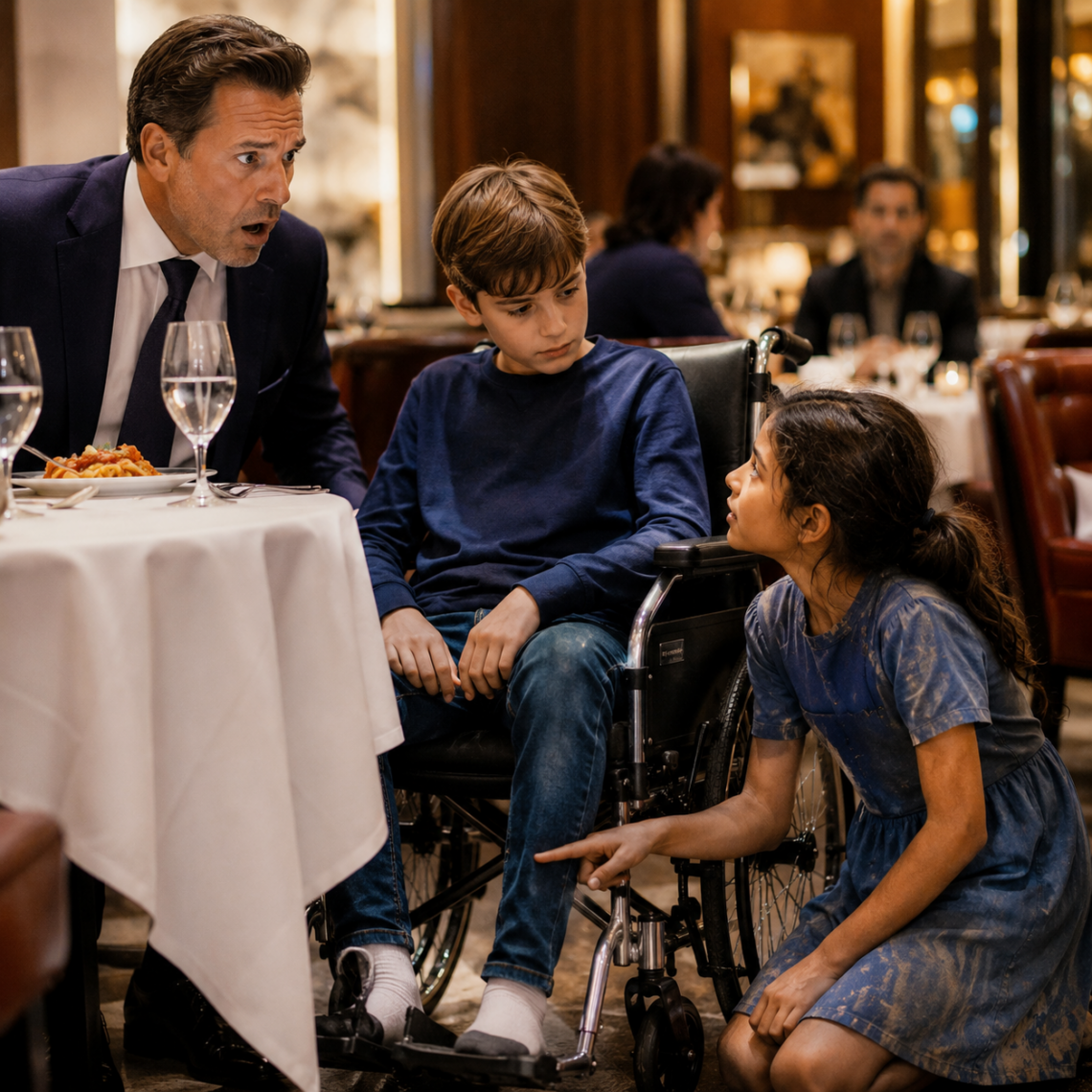
When the poor girl looked at my son and said, “He isn’t paralyzed,” I almost had her thrown out of the restaurant.
My son had not walked in three years.
The best doctors in the country had told me his condition was permanent.
And this child — barefoot, hungry, and no older than twelve — dared to say they were all wrong.
But then she leaned close to my son and whispered something that made his fingers tremble.
That was the moment I realized she didn’t come to beg for food.
She came to uncover the truth I had been too blind to see.
My name is Jonathan Pierce, and three years ago, I lost my wife and almost lost my son on the same night.
Before the accident, my life looked perfect from the outside.
I owned Pierce Holdings, a real estate investment company based in Chicago. I had money, influence, a lakefront mansion, and a wife whose kindness made all of it feel less empty.
Claire was the heart of our home.
She was gentle without being weak, elegant without being proud, and the only person who could walk into my office during a crisis and remind me that dinner with our son mattered more than any deal.
Our son Ethan was ten then.
He was bright, curious, and always moving. He loved soccer, climbing trees, racing down hallways, and asking questions no adult could answer.
“Dad,” he once asked me, “if clouds are made of water, why don’t they fall?”
Claire laughed and said, “Because even clouds know how to hold themselves together.”
I didn’t know those words would haunt me later.
The accident happened on a rainy Thursday night.
Claire had taken Ethan to a school art show. I was supposed to go with them, but a board meeting ran late. I told myself there would be other nights.
There weren’t.
At 9:17 p.m., my phone rang.
A police officer told me there had been a crash near Riverside Bridge.
By the time I reached the hospital, Claire was gone.
Ethan survived.
But when he woke up, he couldn’t move his legs.
The doctors said his spine had been severely injured. They used careful words at first — inflammation, trauma, uncertainty. Then, weeks later, the word became final.
Permanent.
I built my grief into action because action was easier than feeling.
I hired specialists from New York, Boston, Los Angeles. I paid for private consultations, experimental equipment, therapy rooms in our home.
Nothing changed.
Ethan grew quieter.
His legs grew thinner.
His laughter became rare.
And I became a man who lived beside his son’s pain without knowing how to reach him.
A year after Claire’s death, I married Vanessa.
I can admit now that I did not marry her out of love.
I married her because she was there.
She had been Claire’s friend once, or so I believed. After the funeral, she visited often. She brought meals. She sat with Ethan. She told me I didn’t have to carry everything alone.
“You need someone steady,” she said. “For Ethan’s sake.”
I wanted to believe that.
Vanessa was beautiful, organized, and calm in a way that felt like control disguised as care.
She took over Ethan’s medication schedule. She spoke to his doctors. She hired a private therapist named Dr. Harlow, who assured me that Ethan’s weakness was expected.
“He needs rest more than pressure,” Dr. Harlow said. “Too much physical therapy could traumatize him further.”
So I stopped pushing.
I mistook stillness for protection.
By the third year, Ethan spent most days in his wheelchair by the window, watching other children ride bikes on the street below.
Then came the evening that changed everything.
We were eating dinner at a restaurant downtown — one of those quiet places with white tablecloths, candlelight, and waiters who never raised their voices.
Vanessa was out of town visiting her sister, so it was only Ethan and me.
I had ordered his favorite pasta, but he barely touched it.
“Not hungry?” I asked.
He shrugged.
“I’m tired.”
He was always tired.
I was about to call for the check when a girl appeared beside our table.
She was thin, with dark curls tied back under a faded scarf. Her coat was too large for her shoulders, and her shoes were worn nearly flat. She held herself carefully, like someone used to being pushed away.
“Sir,” she said softly, “may I have something to eat?”
The waiter rushed over.
“I’m sorry, Mr. Pierce. I’ll remove her.”
But Ethan looked up.
“Wait.”
The girl’s eyes moved to him.
For a few seconds, she stared at his wheelchair. Not rudely. Not with pity.
With attention.
Then she said the words that made my blood rise.
“Your son isn’t paralyzed.”
The restaurant went silent around me.
I placed my napkin on the table.
“What did you say?”
She swallowed but did not step back.
“He isn’t paralyzed. Not the way you think.”
I stood.
“You don’t know my son. You don’t know his medical history. And you have no right to say something like that.”
The waiter moved closer.
“Sir, should I call security?”
The girl’s face tightened, but her voice stayed calm.
“My grandmother helped people after injuries. I know what dead muscles look like. His aren’t dead. They’re asleep.”
I almost laughed from anger.
“Asleep?”
Ethan whispered, “Dad…”
But I was too furious to listen.
“This is cruel,” I said. “Do you understand that? Giving false hope to a child?”
The girl looked at Ethan, not me.
“Can you feel your knees when someone touches them?”
Ethan hesitated.
“Sometimes.”
My breath caught.
He had never told me that.
The girl nodded slowly.
“And when you dream, do you ever run?”
Ethan’s eyes widened.
“Yes.”
I stared at my son.
“Ethan?”
He looked ashamed.
“I didn’t want to tell you. You get sad whenever I talk about walking.”
The words struck me harder than the girl’s accusation.
The girl stepped closer.
“What’s your name?” she asked him.
“Ethan.”
“I’m Maya.”
I wanted to end it there.
But Ethan’s face had changed.
For the first time in months, he looked awake.
“Please, Dad,” he whispered. “Let her talk.”
Against every instinct, I sat back down.
I ordered food for Maya.
She ate quietly, carefully, as if afraid someone might take the plate away. When she finished, she wiped her mouth with a napkin and looked at me.
“Take him somewhere private. I can show you something.”
“This is ridiculous,” I said.
Ethan touched my sleeve.
“Please.”
So I did.
There was a small courtyard behind the restaurant, closed for winter but lit by soft lamps. I wheeled Ethan there while Maya walked beside us.
The cold air smelled like rain.
Maya knelt in front of Ethan and asked permission before touching his legs.
That surprised me.
Adults often touched Ethan without asking.
Doctors, nurses, therapists — they moved his body as if he were equipment.
Maya waited until he nodded.
Then she placed her fingers along his shin and pressed gently.
“Tell me what you feel.”
“Pressure.”
She moved lower.
“Here?”
“Warm.”
She looked up at me.
“Paralyzed people with complete injury don’t feel this much.”
I folded my arms.
“You’re twelve.”
“Thirteen,” she corrected.
“That doesn’t make this medicine.”
“No,” she said. “But it makes it worth checking.”
Then she asked Ethan to close his eyes.
She tapped his left foot.
“Which side?”
“Left.”
She tapped the right.
“Right.”
I felt the world tilt.
For three years, I had believed my son’s legs were gone to him.
Maya looked at me.
“Who told you he couldn’t recover?”
“Doctors.”
“Which doctors?”
I frowned.
“Many.”
“Who controls what they see?”
The question irritated me because I didn’t understand it.
“What does that mean?”
“Someone decides what records are sent. Someone gives medicine. Someone tells you what questions to ask.”
I thought of Vanessa.
Her folders.
Her calls.
Her insistence that Ethan not be pushed.
Maya continued.
“He’s afraid.”
“Of course he’s afraid. He was in a crash.”
“No,” she said softly. “Not afraid of walking. Afraid of remembering.”
Ethan went pale.
I looked at him.
“Remembering what?”
His fingers tightened around the blanket over his lap.
“Nothing.”
Maya lowered her voice.
“Sometimes the body holds still because the mind thinks moving will bring the bad thing back.”
“That sounds like nonsense,” I said.
But Ethan was shaking.
Maya reached into her coat pocket and pulled out a small wooden bead bracelet.
“My grandmother gave me this,” she said to him. “When I was scared, she told me to look at one bead and say one true thing.”
Ethan stared at the bracelet.
“One true thing?” he whispered.
Maya nodded.
“Not the whole story. Just one true thing.”
A long silence passed.
Then Ethan said:
“It was raining.”
My chest tightened.
“Yes,” I said carefully. “The night of the accident.”
He swallowed.
“Mom was driving.”
I knelt beside him.
“Yes.”
His breathing quickened.
“She was crying.”
I froze.
Claire crying?
The police report had said she lost control on the wet road.
“She was crying?” I asked.
Ethan nodded, tears filling his eyes.
“They were arguing.”
My skin went cold.
“Who?”
Ethan’s lips trembled.
“Mom and Aunt Vanessa.”
The courtyard seemed to go silent.
Vanessa had told me she was at home that night.
Maya looked at me but said nothing.
I forced my voice to stay calm.
“Ethan, Vanessa was in the car?”
He covered his face.
“I don’t know. Not in our car. On the phone. Mom had it on speaker.”
My heart began pounding.
“What were they arguing about?”
Ethan shook his head.
“I don’t want to.”
Maya whispered, “One true thing.”
Ethan looked at the bracelet.
Then he said:
“Vanessa said Mom should tell you the truth before someone else did.”
I felt as if the air had been knocked from my body.
“The truth about what?”
Ethan started crying.
“Mom said, ‘Leave my family alone.’ Then there were headlights. A horn. Mom screamed. Then everything broke.”
He bent forward, sobbing.
I reached for him, but he flinched at first — not from me, from the memory.
Maya gently placed the bracelet in his hand.
“That’s enough,” she said.
I looked at her.
“How did you know?”
Her expression changed.
Pain moved across her face like a shadow.
“My brother stopped walking after he saw our father get killed,” she said. “Doctors said injury. My grandmother said fear can lock a body like a door. She helped him walk again.”
“Where is your brother now?”
Maya looked down.
“Gone.”
The word told me not to ask more.
That night, I took Ethan home and did not give him the evening medication Vanessa had prepared.
For the first time in months, he stayed awake through an entire movie.
After he fell asleep, I went into my office and pulled out the accident file.
I read every page.
Then I read it again.
The report said Claire was alone with Ethan.
No mention of a phone call.
No mention of another vehicle.
No mention of Vanessa.
I checked Claire’s old phone records.
The company had archived them through my family account.
At 9:03 p.m., fourteen minutes before the crash, Claire had received a call from Vanessa.
The call lasted eleven minutes.
My hands shook.
I requested traffic camera footage from the bridge area. My lawyer warned me that after three years, most footage would be gone.
But one private warehouse near the intersection still had archived security backups because of an insurance dispute.
Two days later, I watched the video.
Claire’s car entered the frame in heavy rain.
Behind it was a dark SUV.
Too close.
Aggressive.
The SUV swerved forward.
Claire’s brake lights flashed.
Then the SUV clipped the rear corner of her car.
Claire’s vehicle spun toward the bridge barrier.
The SUV slowed for three seconds.
Then drove away.
I knew that SUV.
Vanessa had owned one exactly like it.
The room blurred.
I had spent three years grieving beside the woman who may have caused the crash that killed my wife.
I called my attorney.
Then a private investigator.
Then the police.
But I needed one more thing.
The medication.
Maya’s words returned: Someone gives medicine.
I sent Ethan’s pills to a lab under a false name.
The results came back within forty-eight hours.
They were sedatives and muscle relaxants.
Not nerve medication.
Not recovery support.
They were suppressing him.
Weakening him.
Keeping him still.
When Vanessa returned from her trip, I was waiting in the living room.
Ethan was upstairs with a nurse I trusted.
Vanessa came in smiling, pulling off her gloves.
“You look serious,” she said.
I placed the pill bottle on the table.
“What is this?”
She glanced at it.
“Ethan’s medication.”
“No,” I said. “It’s a sedative.”
Her smile faded.
“What are you talking about?”
“I had it tested.”
Her eyes sharpened.
“You had no right to change his treatment without speaking to me.”
“He’s my son.”
“I have cared for him for three years.”
“You have kept him weak for three years.”
She stared at me, then laughed softly.
“You’re emotional. This is what happens when you chase miracle cures from street children.”
I stepped closer.
“Claire spoke to you the night she died.”
For the first time, Vanessa went still.
I watched the color leave her face.
“She called me,” Vanessa said carefully. “I told the police that.”
“No. You didn’t.”
Silence.
I placed a printed still from the traffic video beside the pills.
A dark SUV in the rain.
Her eyes flicked down.
Then up.
Something in her mask cracked.
“You don’t understand,” she whispered.
“Then explain.”
Her lips trembled, but not from guilt.
From rage.
“Claire was going to ruin everything.”
“What truth did she know?”
Vanessa’s eyes filled with hatred.
“That you were supposed to be mine first.”
I stared at her.
She continued, voice shaking.
“Before Claire, before your perfect little family, you and I had something.”
“We dated for three months in college.”
“You forgot. I didn’t.”
My stomach turned.
“Claire knew you were harassing her.”
“She called it harassment because she was afraid. She always acted so innocent. Everyone loved Claire. Sweet Claire. Perfect Claire.”
Her voice broke into a bitter laugh.
“She found out I had been sending messages. She said she would tell you everything. She said I needed help.”
“So you followed her?”
Vanessa’s face hardened.
“She was upset. Driving too fast. I just wanted her to pull over.”
“You hit her car.”
“She shouldn’t have tried to run.”
The room went cold.
“And Ethan?”
Vanessa looked toward the stairs.
“He remembered pieces. Nightmares. Words. I couldn’t risk him telling you before he understood.”
“So you drugged him.”
“I protected us.”
“No,” I whispered. “You protected yourself.”
She stepped toward me, tears now streaming down her face.
“I loved you. I stayed when she died. I helped raise your broken son.”
I felt fury rise through me like fire.
“Do not call him broken.”
At that moment, Ethan’s voice came from the hallway.
“I’m not broken.”
We both turned.
He sat in his wheelchair at the entrance, pale but awake.
Behind him stood the nurse, terrified.
Ethan looked at Vanessa.
“I remember your voice.”
Vanessa shook her head.
“No, sweetheart, you’re confused.”
Ethan gripped the wooden bead bracelet Maya had given him.
“One true thing,” he whispered.
Then he looked at me.
“She said, ‘If I can’t have him, neither can you.’”
Vanessa lunged toward him.
I stepped between them before she could reach him.
The nurse screamed.
Police, already waiting outside on my attorney’s instruction, entered seconds later.
Vanessa fought as they handcuffed her.
“This is my life!” she screamed. “Claire stole my life!”
No one answered.
Because madness can explain cruelty.
It does not excuse it.
Vanessa was arrested for Claire’s death, child endangerment, medical fraud, and conspiracy with Dr. Harlow, who later admitted he had prescribed Ethan unnecessary medication in exchange for payments.
The headlines were brutal.
But I barely noticed them.
My world had narrowed to one thing:
Ethan.
With the drugs stopped and a new medical team in place, we learned the truth.
His spinal injury had been serious, but incomplete.
Recovery had always been possible.
Difficult, yes.
Slow, yes.
But possible.
The doctors had missed it because the wrong records had followed him, the wrong assumptions had shaped his care, and the wrong people had controlled his treatment.
Ethan began therapy again.
Real therapy.
Painful therapy.
The kind that left him exhausted but proud.
Maya visited once after everything came out.
I had searched for her through shelters and community centers until I found her at a church-run youth program.
When she entered our home, Ethan smiled wider than I had seen in years.
“You came back,” he said.
She shrugged.
“You still owe me proof.”
“Proof of what?”
“That I was right.”
He laughed.
It was the first real laugh in our house since Claire died.
I offered to help Maya. Money, school, a safe place to live. Anything.
She looked suspicious at first.
“I didn’t do it for payment.”
“I know,” I said. “That’s why I trust you.”
Eventually, with help from social services and her consent, Maya moved into a stable foster home connected to the youth program. I funded her education anonymously at first, but she figured it out within a month.
“You’re not very good at being anonymous,” she told me.
“No,” I admitted. “But I’m trying to be good at being grateful.”
Six months later, Ethan stood between parallel bars in our therapy room.
His hands gripped the rails.
Sweat ran down his face.
His legs trembled violently.
“I can’t,” he gasped.
Maya stood at the end of the bars with her bracelet wrapped around her wrist.
“One true thing,” she said.
Ethan closed his eyes.
Then he whispered:
“I’m scared.”
Maya nodded.
“Good. Another.”
“I miss Mom.”
My throat tightened.
“Another.”
Ethan opened his eyes.
“I want to walk to Dad.”
I covered my mouth.
His therapist nodded.
“Whenever you’re ready.”
Ethan took one step.
Then another.
His knees nearly buckled, but he held on.
By the third step, I was crying too hard to see clearly.
He reached the end of the bars and fell into my arms.
For three years, I had carried grief like a stone inside my chest.
That day, for the first time, it cracked open.
Not disappeared.
Grief doesn’t disappear.
But light got in.
Later, after everyone left, Ethan and I sat by the window where he used to watch other children play.
He leaned against me and said:
“Dad?”
“Yes, buddy?”
“Do you think Mom knows?”
I looked at the evening sky.
Claire had loved sunsets.
“I think she knows everything that matters.”
He nodded.
“Maya said my legs were asleep.”
I smiled.
“She was right.”
“No,” he said thoughtfully. “I think we were all asleep.”
I looked at him.
And I knew exactly what he meant.
I had been asleep in guilt.
Ethan had been asleep in fear.
Our home had been asleep under lies.
And a hungry girl in a faded coat had walked into a restaurant and woken us all.
Years have passed since that night.
Ethan still walks with a brace sometimes. Some days are harder than others. But he walks.
He plays adapted soccer now. He races slower than other kids but laughs louder than all of them.
Maya is in college studying physical therapy.
She says she wants to help children whose bodies are listening to fear instead of hope.
As for me, I no longer believe wealth can protect a family.
Money can hire doctors.
Money can buy medicine.
Money can build houses with gates and cameras and guards.
But money cannot replace attention.
It cannot replace truth.
It cannot replace listening when a child says something adults are too proud to hear.
The girl I nearly threw out of a restaurant gave me no miracle cure.
She gave me something better.
A question.
What if everyone is wrong?
That question saved my son.
It exposed the woman who destroyed my wife.
And it taught me that sometimes healing does not begin with an answer.
Sometimes healing begins when someone brave enough, hungry enough, and honest enough looks at the truth and says:
“Your son isn’t paralyzed.”
And this time…
You finally listen.