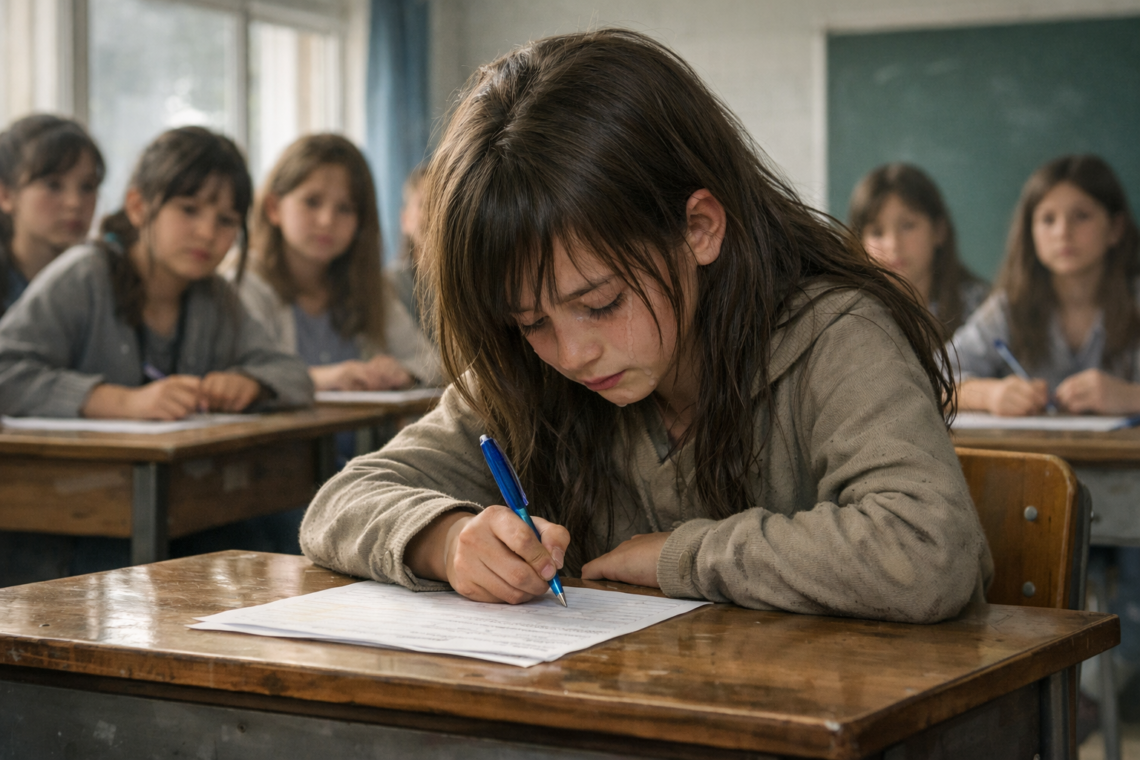
When the teacher asked the students to write a letter to their parents, the classroom filled with the soft scratch of pens on paper. Heads bent down. Hands moved quickly. But one girl just sat there, frozen, staring at the blank sheet in front of her.
A few students noticed.
Then someone laughed.
“She doesn’t even have a pen,” one boy whispered loudly enough for the whole row to hear.
A few more kids giggled. Someone muttered that she was always forgetting things. Another said maybe she was just trying to get attention.
The girl kept her eyes on the paper and said nothing.
Her backpack was old. Her sleeves were too short. And now, with the whole class writing and her empty hands resting on the desk, she looked smaller than ever.
The teacher turned from the board and saw her sitting there motionless.
“Why haven’t you started?” she asked gently.
The girl swallowed, but no words came out.
The room had gone quiet now.
Without saying anything else, the teacher walked over, reached into her desk, and placed a blue pen in front of her.
It was such a small thing.
But the moment the pen touched the desk, the girl’s face changed.
Her lips trembled.
Her eyes filled.
And then, in a voice so soft it barely sounded real, she whispered,
“I can’t write to my mom… she died last week.”
No one laughed after that.
The silence in the room felt different now — heavy, painful, ashamed.
The teacher’s expression broke. She slowly knelt beside the girl’s desk, one hand resting lightly near her arm, as if afraid even kindness might hurt.
The students who had laughed looked down at their papers.
One girl in the front row quietly wiped her eyes.
The teacher looked at the blank page, then back at the child.
“You don’t have to write a letter,” she said softly. “You can write anything you want. Or nothing at all.”
But the girl shook her head.
Tears slipped down her cheeks as she picked up the pen with shaking fingers.
“I just…” she whispered, struggling to breathe steadily. “I don’t know how to talk to her if she can’t read it.”
The teacher covered her mouth for a second, trying not to cry in front of the class.
Then, very quietly, she said, “Sometimes we write not because they can read it… but because we still need to say it.”
The girl looked at her.
For the first time that morning, she lowered her eyes to the page and began to write.
Not quickly. Not neatly. Just one trembling word at a time.
Around her, no one moved.
No one rushed.
And for the rest of that class, the only sound in the room was the soft scratching of one pen on paper.
If you want, I can turn this into 10 more stories in the exact same emotional style.