The bell above the door gave a tired little ring as she stepped inside.
It was the middle of the afternoon, and the shop was nearly empty — just dusty shelves, old watches, tangled cords, and glass cases filled with things people once promised themselves they’d come back for.
Behind the counter, the owner looked up and froze.
The girl couldn’t have been older than nine.
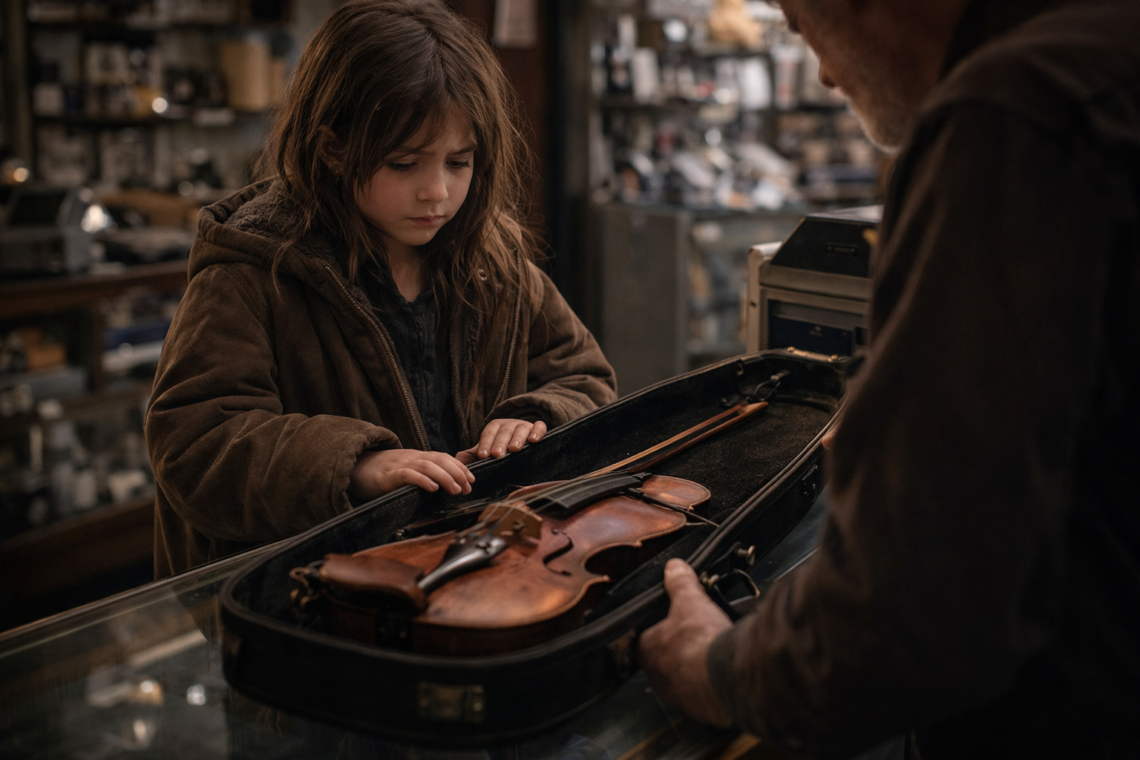
Her coat was too thin for the weather. Her shoes were damp at the toes. And in her small hands, she carried a violin case so large it looked like it might pull her sideways if she let go for even a second.
At first, he thought the same thing he probably would have thought of any child walking in alone with something valuable.
Stolen.
He straightened up immediately.
“Where did you get that?” he asked, sharper than he meant to.
The girl flinched, but she didn’t back away.
Instead, she walked to the counter, lifted the case with both hands, and set it down carefully — almost lovingly.
“It was my mom’s,” she said.
The owner didn’t open it right away.
He studied her face, waiting for the story to fall apart.
Kids who lied usually talked too fast. They filled silence with extra details. They looked around for exits.
But this girl just stood there quietly, both hands resting on the closed case as if she were protecting it.
“Your mom sent you in here alone?” he asked.
She nodded once.
That answer didn’t make him feel any better.
Slowly, he opened the case.
Inside was a real violin. Old, but well cared for. The wood was worn smooth where years of fingers had loved it. The velvet lining was faded. One string looked newer than the others, like someone had repaired it instead of replacing the instrument.
Not junk.
Not a toy.
Something that had mattered.
The owner looked back at the girl. “Does she know how much this could be worth?”
The child swallowed.
“Yes.”
“And she still wants to sell it?”
For the first time, the girl’s expression changed.
Not anger. Not fear.
Just the kind of sadness that looks too old on a child’s face.
“She said music should be the last thing we sell,” the girl answered softly.
The owner’s hands stopped moving.
The shop felt quieter somehow.
He glanced at the violin again, then back at her.
“Then why are you here?”
The girl lowered her eyes to the counter.
When she spoke, her voice was so small it barely seemed to reach him.
“Because the baby needs formula first.”
The words hit harder than he expected.
He looked at her more closely then — really looked.
The tired eyes. The sleeve she kept pulling down over her hand. The way she kept glancing at the door like she was afraid she had already been gone too long. The fact that she never once asked how much he would give her.
Only whether he would.
“Your baby brother?” he asked quietly.
She nodded.
The owner looked down at the violin again.
He had spent twenty-three years in that shop listening to stories. Some true. Most not. He knew the sound of desperation, of addiction, of regret, of lies dressed up as emergencies.
But this was different.
This was a child standing in front of him trying to trade away the last beautiful thing in her house because someone smaller than her was hungry.
He closed the case gently.
Then he pushed it back toward her.
The girl’s face fell. “Please,” she whispered. “I have to bring something back.”
The owner reached into his wallet.
He took out more cash than the violin would have brought on a bad day and placed it on the counter.
Her eyes widened.
“I can’t take that if you’re not keeping it,” she said.
“Yes, you can,” he replied.
She shook her head quickly. “My mom said we don’t take pity.”
The man was quiet for a moment.
Then he said, “Good. Because this isn’t pity.”
He slid the money a little closer.
“It’s a loan against something too important to lose.”
The girl stared at him.
Her fingers slowly curled around the edge of the violin case.
“Can I tell her that?” she asked.
His throat tightened.
“Tell her,” he said, “that music can stay a little longer.”
The girl took the money with shaking hands, hugged the violin to her chest, and turned toward the door.
But before she left, she looked back and asked the question that stayed with him long after the bell stopped ringing.
“If we come back next week… do you think it will still be enough?”
If you want, I can make 10 more stories in exactly this same emotional style.