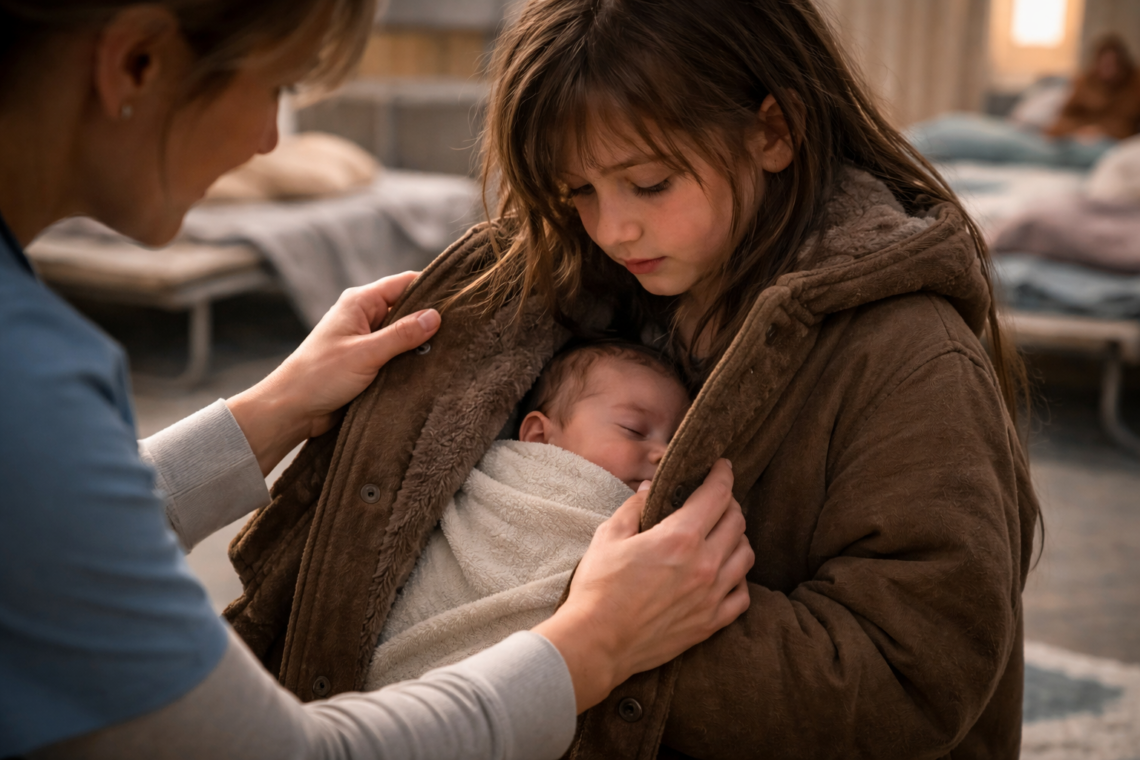
The heating inside the shelter was turned up high that night. Wet shoes lined the wall by the entrance. Steam rose from paper cups of soup. Children sat on folding chairs wrapped in donated sweaters, while volunteers moved from bed to bed, handing out blankets and calling names.
But one little girl stayed near the corner, still wearing her coat.
It was old and far too big for her, buttoned all the way to her chin. Her hair was damp from the cold, and her cheeks were pale, but she refused every offer to take it off.
“At least loosen it,” one staff member said gently. “You’re safe in here now.”
The girl shook her head.
Another volunteer tried later. Then another.
Each time, she stepped back and held the coat tighter around herself.
Some of the other children started whispering.
“She’s weird.”
“Maybe she stole it.”
“Why is she acting like that?”
The staff exchanged tired looks. It had been a long night, and everyone assumed the same thing — that she was frightened, stubborn, or simply used to saying no.
Then a nurse came over.
She didn’t raise her voice. She didn’t rush.
She crouched down until she was at the girl’s eye level and spoke softly.
“Sweetheart,” she said, “I just need to make sure you’re okay.”
The girl didn’t answer.
The nurse waited a moment, then carefully reached for the top button of the coat.
At first, the child flinched.
But she was too exhausted to keep fighting.
Very gently, the nurse unbuttoned the coat.
And then the whole room seemed to stop breathing.
Beneath the heavy fabric, tucked tightly against the girl’s chest, was a sleeping baby.
Tiny. Silent. Wrapped in a thin dish towel and pressed against her body for warmth.
A little boy.
The girl’s arms were locked around him with the kind of strength no child should have to learn.
For a second, no one moved.
The whispers in the room died instantly.
The nurse’s face changed first. Then one of the volunteers covered her mouth. Another turned away with tears already in her eyes.
The girl looked down, ashamed now, like she thought she had done something wrong.
“I’m sorry,” she whispered quickly. “He cries when he gets cold.”
The nurse swallowed hard. “That’s your brother?”
The girl nodded.
“I didn’t want them to separate us.”
Her voice was barely audible.
“He was shaking outside.”
The baby stirred a little, making a weak sound, and the girl immediately pulled the coat around him again by instinct.
It wasn’t defiance.
It wasn’t bad behavior.
It was protection.
The nurse reached out slowly, touching the baby’s tiny hand, then looked back at the girl.
“How long have you been holding him like this?”
The child hesitated.
“Since yesterday.”
No one in that shelter forgot the silence that followed.
Because in that moment, everyone understood the truth:
She hadn’t refused to take off her coat because she was difficult.
She had refused because she had been using the last warmth she had to keep her baby brother alive.
If you want, I can turn this into 10 more stories in exactly this same emotional style.